
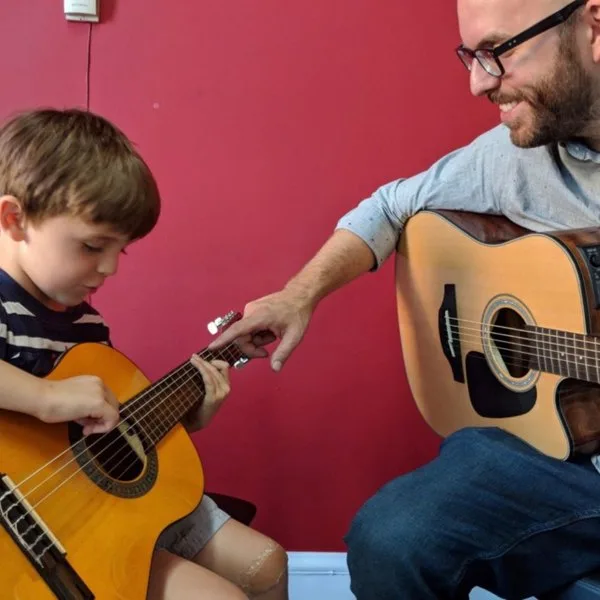
Who guitar lessons are for
Most people who sign up for guitar fall into one of four groups, and we teach all of them:
- Kids starting from zero. If a child can sit with an instrument for thirty minutes, they're ready. Very small hands sometimes do better on a smaller guitar or on ukulele first.
- Teens who want to play the music they listen to. Riffs, power chords and solos from the songs on their playlist, with the theory slipped in along the way.
- Adult beginners. People who have been meaning to start for years. You don't need any background. See lessons for adults.
- Returning and stuck players. You know a handful of chords and have been playing the same four songs since college. A teacher gets you moving again.
What you'll work on
Lessons are built around what the student wants to play. The teacher plans for one person, so a seven-year-old who wants a song from a video game and an adult who wants to strum around a campfire get different lessons. Along the way, everyone covers the same core:
- Chords and strumming. Open chords first, then barre chords and power chords, and changing between them in time.
- Riffs and single-note playing. Picking, fretting cleanly, and the patterns behind most rock and pop lines.
- Reading. Tab first because it gets you playing fast, then standard notation and chord charts as you need them.
- Timing. Playing with a metronome and with recordings, so you can play with other people.
- Electric or acoustic. Either is a fine place to start. Bring the guitar you have.
What a first month looks like
Every teacher adjusts this to the student, but for a true beginner the first four weeks usually go something like this:
Setlist · a first month of guitar
- 1Meet and tune up
Holding the guitar, tuning it, a first chord or riff, and what you want to be playing by summer.
- 2Two chords, one song
Switching between two chords in time. Fingertips get sore. That's normal and it passes.
- 3A third chord and a strum
Most of a real song is now in reach. Short daily practice starts to show.
- 4Play it through
A song from start to finish, a little rough, and a plan for month two.
- EncoreJoin a band
Ages 7 to 18 can add the rock band program once they have a few songs.
Adults often move faster through the first month and slower through the sore-fingers part. Kids are the opposite. Both are fine. For a longer view, read how long it takes to learn guitar.
Practice at home
The weekly lesson is where you learn what to do. Progress happens in the practice between lessons. A few things that help:
- Short and often beats long and rare. Ten or fifteen minutes most days does more than one hour on Sunday.
- Leave the guitar out. On a stand, not in the case. You'll pick it up more.
- Tune every time. A free tuner app is enough. Practicing out of tune trains your ear wrong.
- Practice the hard two seconds. Don't replay the whole song. Loop the chord change you keep missing.
More on this in how much a beginner should practice.
Do you need your own guitar?
You need one at home to practice on. It doesn't need to be expensive, but it does need to be playable: strings low enough to press down and a neck that stays in tune. Our first guitar buying guide covers what actually matters. The Downers Grove studio is lessons only, but Evolution Music sells used gear at its stores in Midlothian and Logan Square and online at evolutionmusicstore.com.
Which lesson length?
Lessons run 30, 45 or 60 minutes. Most young beginners start at 30 minutes, which is about as long as a young child stays focused. Teens and adults who want to cover more ground, or who are past the beginner stage, often choose 45 or 60. You can change length later.
How to get started
- Sign up online. Tell us who's playing and what they want to learn. It takes a couple of minutes.
- Pick a weekly time. It becomes your spot every week with the same teacher. If nothing fits, tell us when you're free.
- Save a card to lock it in. Lessons bill monthly after that, so there are no checks or reminders.
Rather talk to a person first? Text or call (630) 541-5022.